 The Research Competition
 The Research Competition
The researchers are the most numerous players in this scenario activity.
The researchers are members of different professional associations, referred to as Social Science Disciplines:
The researchers are expected to think and act their way to winning the funds needed to complete their team’s research proposal. Each discipline team prepares a research proposal on the assigned topic and presents it to the Judges during the GAME PLAY, an in-class contest. Depending on class size and the number of disciplines selected, there will be between two and five members in each discipline team.
The judges will determine the funding criteria and dispersals for the $1,000,000 available in research funds to the Researchers.
The Judges make up the fictional Research Council that resembles the Social Science and Humanities Research Council of Canada (SSHRC).
The Judges set the stage for a healthy contest among the Researchers who are organized into separate social science discipline teams (i.e., psychology, geography, political science, etc.).
The Judges establish the criteria for granting the $1,000,000 in funds, host the finding competition proceedings and decide which discipline receives what amount.
The Researchers must demonstrate to the Judges that their research proposals are worthy of being funded.
In this role-play scenario, the two Journalists are specialists who cover scientific affairs for a number of reputable Canadian newspapers and magazines. One of them is a gifted photographer.
Specially invited by the Research Council Judges, the Journalists keep a watchful eye on the professional propriety of the Judges and the Researchers, especially when the competition heats up.
The Journalists pose questions during the Q & A period and cover the competition event in a News Report that is released a week after the GAME PLAY. Photos may appear in this in-class publication.
One other player, the General Public demonstrates non-scientific ways of thinking in this role-play scenario.
Instead of thinking scientifically, the General Public thinks in a more practical and commonsensical manner. In its most stereotypical form, the General Public makes hastily drawn conclusions based on limited information coming from such sources as common myths and conceptions, popular media, traditional authority and/or personal anecdotal experience.
Specially invited by the Research Council Judges, the General Public challenges the Researchers to provide cost-efficient and practical research solutions to the problems identified on the assigned topic.
At the commencement of the Fund$ Game, the General Public delivers an opening speech outlining the conventional wisdom regarding research on the assigned topic. The game closes with the General Public reflecting on the extent to which the Judges’ allocation of funds to the discipline groups accords with their own typically non-scientific ways of thinking.
As a Teacher, you direct your students through an in-class role-play scenario about a social science research funding competition across the disciplines. You assign a topic, set the assignment parameters and watch as your students use role-play scripts to act the parts of researchers, judges, journalists and the general public. Finally, you evaluate the meaningful learning that takes place and benefit from the support materials provided on this website.
No matter how many times you play this game, it is always unique and always has its own dynamics and characters.
What is your name?
What are the names of your team members?
What is the assigned topic for the game?
What is your professional role-play name & title? e.g. Dr., Professor, Associate Professor, Director, Lead researcher.
What is your Institutional affiliation? e.g., a university or research centre.
What is your team name? e.g., a professional-sounding name that signifies something about your discipline as well as your approach to the assigned topic.
Review the Code of Conduct under the Rules and Code of Conduct and respond to the questions below.
Which part of the code of conduct do you think you will have no trouble adhering to?
Which part of the code of conduct do you think you may have some trouble adhering to? Why?
In point form, list what you, as an individual, are bringing to the team in terms of knowledge and interests relative to the discipline to which you have been assigned. Consider such things as courses taken, readings, essays written or orals delivered in courses relating to the discipline. Also consider any involvement in volunteer or club activities or jobs you have done that may relate.
Spend 15 minutes browsing through the official website (Canadian or American) of the professional association of your discipline*, and answer the following questions individually (not as a team).
* Examples include the Canadian or American Psychological Association or the Canadian or American Political Science Association. For the Business discipline, these associations are more specific to areas within business, such as marketing, advertising, finance or accounting.
Proposals do not emerge in a vacuum! Researchers generate ideas for future research from previous research.
Each team member finds, in the library’s periodical databases (e.g., Academic OneFile, JSTOR, ProQuest…), one peer-reviwed scholarly journal article specific to the discipline on the assigned topic.
Combine the name of your discipline with the topic in the basic or advanced search box. Limit the search to:
Be sure to choose an article that you can understand.
The studies your team finds will be used to help your team design its own proposal on the topic. The aim is to build on research by researchers in your discipline. Building on previous research is a praiseworthy norm in scientific research.
In point form, take note of the following features of the study you have selected:
Find out about your fellow team members’ studies. Each of you in turn should present the information you extracted from your chosen study. Use the prompt questions below to guide you in your search for your own proposal ideas. Keep track of what you decide to borrow and from whom, as you should make explicit reference to the researchers and the titles during your presentation.
Address the following questions as a team and provide a brief account of the discussion under the three items listed below. For this item, depending on your teacher, your responses may be similar.
This template provides all the parts required for a research proposal.
| FOUR PILLARS | YOUR ANSWERS (RESPOND IN POINT FORM AS A TEAM) |
|---|---|
|
PILLAR A — THE DISCIPLINE PITCH Try to find convincing evidence of the valuable work your discipline is doing on this topic. Remember, you are competing against the other discipline teams for research funding. You have to “sell” your discipline’s proposal.
|
|
|
PILLAR B — THE METHOD PLAN Use the DECISION CIRCUIT for this. Each of the numbered items listed here corresponds to numbered items on the decision boards. Review each DC decision board with your team members and write down your selections in the adjacent column. Elaborate on your responses so that the choices clearly refer to the specifics of your plan. |
|
|
PILLAR C — THE BUDGET AND TIMEFRAME Seek online information for rough, estimated prices of things such as materials, travel costs and salaries.
|
|
|
PILLAR D — THE CLOSING PITCH Highlight key elements of proposal and briefly remind the judges why they should support your proposal.
|
| CRITERIA | NONE AT ALL | VERY LIMITED | MODERATE | HIGH | VERY HIGH |
|---|---|---|---|---|---|
| 1. | |||||
| 2. | |||||
| 3. |
Based on the checklist results above, provide an individual prescription of what you believe could be improved in the proposal and how this could be accomplished.
Fill in the Cue Card Sheet Template below so you and your team members will know who is presenting what and in what sequence. If a team member is prevented from delivering their portion, someone else in the team can step in to fill the gap.
Using material from the completed Design Proposal Template in STEP 5:
See Sample Cue Card Sheet for an example of a completed version.
| Pillar A Discipline Pitch |
|
|
|
|
|
| Pillar B Method Plan |
|
|
|
|
|
| Pillar C Budget and Timeframe |
|
|
|
|
|
| Pillar D Closing Pitch |
|
|
|
|
|
| COLOUR | NAME OF PRESENTER |
|---|---|
Place a check mark beside items that are in order.
Discipline: Religious Studies
Topic: Immigration
We are researchers from the Canadian Institute for Religious Studies – CIRS. Professors Anthony and Gordan are from the Department of Religious Studies at the University of Waterloo, Dr. Lily is currently the Director of the Centre for Therapeutic Uses of Spiritual Practices, and Dr. Samantha is a Senior Lecturer at the University of Chester’s Religious Studies Department and the lead researcher for the Immigrant Religion Project.
What is Religious Studies?
Religious studies is one of the oldest of the social science disciplines, with roots reaching back to ancient philosophy and theology. It was in the 19th century, however, when the systematic study of religious belief systems and practices got underway in the universities.
Misconceptions abound about us as researchers. One such misconception is that we are not researchers, but rather proselytizers trying to convert people to a particular faith. This is not at all true, as we aim to illuminate not the eyes of people’s souls, but the scientific understanding of phenomena we consider to be religious.
We study the migration and immigration of peoples of many faiths. Our approach is both historical – by looking to past events, especially religious persecution and genocides – and comparative.
As scientists, we frequently compare different belief systems, practices and behaviours across time and socio-demographic factors. To do this, we typically use surveys (questionnaires, interviews…), fieldwork, case studies and the analysis of available statistics. Our focus on religion, as a discipline of science, has given us very tangible insight into major issues affecting immigrants, across time and geographical locations.
Many immigrants are known to have religion-based adjustment issues in host countries, and religious studies can help to identify and address these adjustment issues.
After reviewing the research on religion and immigration, we found a Statistics Canada report on the “healthy immigrant effect” that we would like to build on. Edward Ng (2011) and the Longitudinal Health and Administrative Data research team analysed the health characteristics of immigrants and non-immigrants and found that immigrants, especially those with strong religious and traditional values, suffer fewer instances of chronic disease, disability, depression, suicide and drug addiction.
The Ng (2011) study challenges the conventional wisdom that immigrants are a strain on the medical system, yet it does not seek explanations: Why/how might religion factor into the “healthy immigrant effect”?
Therefore, we would like to address the following as-yet unanswered questions:
Finding answers to these questions could benefit agencies and social and religious community networks that have regular contact with immigrant groups. A better understanding of how and which religious factors contribute to healthier outcomes could provide more targeted and cost-efficient policies and programs for immigrant groups.
What we want to do is to systematically conduct two hypothesis tests:
The approach will be descriptive in orientation. The goal is to develop a more accurate understanding of how religious belief and values impact on the immigrant experience.
We are seeking funding to support our investigation into how religion factors into the “healthy immigrant effect.”
There is no need to directly source the data ourselves with reactive methods requiring us to go out to collect raw data, as fortunately there is an abundance of quantitative data already available in Statistics Canada and Health Canada datasets. This data is readily available, free of charge, via the Internet.
The units studied will be recent Canadian immigrant groups. The sampling strategy is to purposively select non-representative Statistics Canada data sources for the past decade on recent Canadian immigrants by religious belief and health status. Thus far, we are aware of two major datasets. The selection strategy used by Statistics Canada for each data set will be clearly indicated. It should be noted that in some cases, the data were collected from the entire target population, not a sample proportion of the population.
We may have some trouble finding more than basic information related to religious factors. We will therefore need to consult with some specialists at Statistics Canada and Health Canada for some assistance in getting access to more detailed datasets. The sampling strategy is therefore open-ended and somewhat theoretical in orientation.
Secondary analysis will be the technique used to systematically collect and process the data. Using data that have already been gathered by reputable agencies such as Statistics Canada and Health Canada is cost-effective and allows for valid testing of the hypotheses.
A standardized plan is in place to use the data processing tools in a spreadsheet program, Microsoft Excel. The data will be entered into Excel spreadsheets and the appropriate statistical tables and graphic displays will be generated to reflect the two planned hypothesis tests.
A variety of deductive types of analyses will be used to test the two hypotheses. We intend to enter the available medical and socio-demographic data into Excel and run the following statistical tests: chi-square and independent samples t-test to test for differences in religious groups, and linear regression to test for strength, direction and predictive value of associations. Some more inductive types of analysis will also be used, mostly in the form of the descriptive statistical analysis of differences based on measures of central tendency and spread.
There are several sources of bias and limitations inherent in this study design. Firstly, illegal immigrants and immigrants awaiting formal status recognition, especially recent refugees, will not be properly accounted for in the datasets and as such could produce a systematic underrepresentation of this group in the results. As well, since we have opted to not collect the data ourselves and rather use available data, we are not able to fully manipulate the data according to our needs. For instance, we may not be able to obtain information for specific aspects of religious adherence such as degree of religiosity and specific forms of religious beliefs. We find these limitations to be acceptable as the costs and time required to conduct our own lengthy survey of a large country-wide target population are prohibitive.
In terms of ethics, there will be no need to obtain voluntary consent from the research subjects as the data were already collected by reputable government agencies and medical staff. The sources of information will be fully credited.
The four of us expect to complete the gathering, processing, analysis and reporting of the data in 12-16 months. At $70 per hour with all four of us working on a part-time basis, we estimate salary expenses to amount to about $145,000 over the year. We will require some support ($50,000) for data software, computer units and Internet access for the four of us. Some travel to Ottawa and other data centres will be necessary on occasion. We may even have to purchase some datasets which, combined with the travel, could account for roughly $5,000. All of this will come to a GRAND TOTAL of $200,000 CDN.
Too many misconceptions surround immigration and immigrants. Immigrants are often considered to be expensive dependents, costing Canadian taxpayers more than the immigrants are expected to contribute to the Canadian economy. Ng (2011) has already demonstrated this to be a misconception and the idea needs to be challenged further. Such misconceptions contribute to a dangerous climate of anti-immigration and should be countered with a cold, hard look at the facts.
Anthony / Gordan / Sam / Lily
4 qualified applicants from CIRS:
One of oldest disciplines: Goes back to ancient philosophy and theology, more recently in 19th century
We are scientists; not trying to spread faith or religious belief
Use many techniques: survey method, fieldwork, available statistics …
IMMIGRATION important – religious studies compare across time & socio-demographic factors of religious belief, practices & behaviours of different IMMIGRANT groups.
Edward Ng (2011) and the Longitudinal Health and Administrative Data research team: healthy immigrant effect.
Questions:
Hypotheses:
Main variables in H1:
Main variables in H2:
Adopting linear path
Decided not to use direct/reactive methods – no need. Lots of data already available as shown in Ng (2011) study that we are building on.
Secondary analysis of available statistical data is the strategy. Statistics Canada/Health Canada datasets from the years 2000-2010. Data collected from medical files and cross-referenced with socio-demographic information relating to country of origin, religious denomination.
Enter the data into reputable data processing software – Excel.
Run the following statistical tests: chi-square and independent samples t-test to test for differences in groups, and linear regression to test for strength of associations.
The target population will be recent immigrants to Canada in the past decade. There is no sample as the data collected by StatsCan is the available target population.
Current perceptions are not based on facts.Requires scientific evidence and Religious Studies understands the value of religious beliefs and traditional values.
What is your name?
What are the names of your fellow judges?
What is the assigned topic for the game?
Take about 15 minutes to search online for information regarding funding agency judges and what they do. Go to the Social Science and Humanities Research Council of Canada (SSHRC) website and explore SSHRC merit reviews.
|
Did you know that... A research council typically consists of a number of eminent scholars and distinguished experts from industry and government who have been selected by the governing body of a funding agency. At the federal level in Canada, the Ministry of Industry oversees the operations of three federal granting agencies, referred to as the Tri-Council. The Social Science and Humanities Research Council of Canada (SSHRC) is one of these three councils, the others being Canadian Institutes for Health Research (CIHR) and Natural Sciences and Engineering Research Council (NSERC). Combined, their mandate is to support post-secondary scientific inquiry in academia and in the public and private sectors. Council members are selected for their expertise and professionalism and are usually drawn from different sectors of society. |
Based on your search of SSHRC, provide brief responses to the following questions:
Take another 15 minutes to explore the governance section of the SSHRC website. Look for prospects for a role-play name and title. Discuss the prospects with your fellow judges. Choose a name, professional title and institutional affiliation.
What is your:
Assign each judge a specialized council position, such as President, Vice-President, Chairperson, Secretary, or Treasurer.
Review the Code of Conduct under the Rules and Code of Conduct and respond to the questions below.
Which part of the code of conduct do you think you will have no trouble adhering to?
Which part of the code of conduct do you think you may have some trouble adhering to? Why?
Read the Topics and Proposal Abstracts for The FUND$ GAME
Using the table below, on a scale of 1-10 where 1 represents the lowest level of knowledge and 10 the highest, estimate your level knowledge for each of the disciplines:
| DISCIPLINE | COMBINED LEVEL OF KNOWLEDGE ON 1-10 SCALE, LOW TO HIGH |
|---|---|
| Anthropology | |
| Business | |
| Economics | |
| Geography | |
| History | |
| Philosophy | |
| Political Science | |
| Psychology | |
| Religious Studies | |
| Sociology |
Compare rankings above with your fellow judges. Identify three disciplines about which you, as a team, have deficient knowledge and briefly explain how you intend to redress this.
Which two disciplines do you feel you know the least about?
Visit the professional association website for these two disciplines. Navigate through each site for a few minutes. Eventually, jot down a few points you have learned about each discipline. (Search “Canadian” or “American” before the discipline name, followed by the word “Association,” such as “Canadian Political Science Association.”)
Read the Sample Research Proposal on your own and identify three features that you believe should be subjected to scrutiny. In other words, what aspects of the proposal stand out as elements that should be evaluated by you, the judges?
What is your assigned topic for the FUND$ GAME?
Consult a specialized social science encyclopedia in your college library’s e-book collection, book stacks or database. Search for an entry/article on the assigned topic.
The length of these entries ranges between 1 to 5 pages. Aim for an entry that provides an overview of the research and the disciplines or fields involved. Popular encyclopaedias such as Britannica or Wikipedia are not appropriate as there is no guarantee that the authors are qualified specialists in the field. For instance, The International Encyclopedia of the Social & Behavioral Sciences is a 26-volume specialized encyclopedia that is available in most academic libraries. You may require the teacher’s guidance for this item.
Take note of the following:
“
“
Page number:
| FUNDING CRITERIA | PERFORMANCE INDICATOR(S) |
|---|---|
|
|
|
|
|
|
|
|
|
Create score sheets for use during the GAME PLAY.Design them with efficiency in mind. While judging, you will be multi-tasking; actively listening, taking notes, scoring performances, directing presentations. The players will expect the judges to sustain an even, brisk pace. There will be only a minute between presentations to complete your scoring and then, after all the proposals are presented, only 15 minutes to make your funding dispersal decisions. Well-designed score sheets are indispensable.
As a team, determine how you plan to announce the winners and the losers. For fairness and equivalence, it is advisable to tabulate numeric scores using the criteria. Judgment will be required to apportion the $1M. Some teams may receive nothing. In this case, you may consider suggesting that the team address those areas in need of improvement and re-submit for the following round of funding.
Review the GAME PLAY Agenda & Set Design. As a team, list all the equipment and printed or electronic materials needed for the GAME PLAY. You may want to discuss these plans with the teacher.
| I AM RESPONSIBLE FOR THESE ITEMS |
OTHERS ARE RESPONSIBLE FOR THESE ITEMS (WHO?) |
ITEMS FOR GAME PLAY | QUESTIONS |
|---|---|---|---|
|
|
Access to score sheets for judges | ||
|
|
Team name placards | ||
|
|
Funding currency | ||
|
|
Access to GAME PLAY Agenda & Set Design | ||
|
|
Materials/Equipment for reporting information (markers, projector, screen …) | ||
|
|
Judge’s gavel or other such device | ||
|
|
Timer |
| CRITERIA | PERFORMANCE INDICATORS |
|---|---|
| 1. Well-organized & prepared |
|
| 2. Positive repercussions on society |
|
| 3. Cost-effectiveness |
|
Discipline: _________________
| CRITERIA | 1-3 | 4-7 | 8-10 | SCORE |
|---|---|---|---|---|
| 1. Sound, Logical Proposal |
Proposal is vague and unclear; lacks grounding in research field; limited reference to scientific terms or data gathering or sampling plan; may not be ethical (probably too vague to determine). | Proposal makes some sense and is fairly logical in sequence; some connection to existing research in the discipline; weak/limited choice of methods for gathering data, selecting sample and analyzing data; limited use of scientific terminology; could be ethical. | Proposal is very clear and makes lots of sense; grounded in existing research in the discipline; excellent choice of methods for gathering data, selecting sample and analyzing data; sophisticated use of scientific terminology; ethically sound. | |
| 2. High Impact Potential |
Little to no evidence provided of the value of investing in this research; unclear or vague path to impact in the field. | Some support for research leading to breakthroughs; evidence of some potential for making improvements; some justification for investing in this research project. | Convincing case for research leading to major breakthroughs; demonstrated potential for research to contribute to improvements; justified value of investing in this research project. | |
| 3. Professionalism | Researchers lacked professionalism in some ways: Weak team work, disorganized presentation, potentially unethical plans or work processes, lack of accountability for monies and materials required. |
Researchers demonstrated some professionalism: worked together, presented in an organized fashion, adhered to ethical rules of conduct, costed and planned work with some degree of accountability. | Researchers demonstrated professionalism: worked well together presented in a highly organized fashion, adhered to ethical rules of conduct, costed and planned work in a detailed and accountable manner. | |
| TOTAL SCORE |
||||
| Comments | ||||
| DISCIPLINE | CRITERION 1 1-10 |
CRITERION 2 1-10 |
CRITERION 3 1-10 |
SCORE |
|---|---|---|---|---|
| 1. Anthropology | ||||
| 2. Business | ||||
| 3. Economics | ||||
| 4. Geography | ||||
| 5. History | ||||
| 6. Philosophy | ||||
| 7. Political Science | ||||
| 8. Psychology | ||||
| 9. Religious Studies | ||||
| 10. Sociology |
To show funding distribution choices of Judges and General Public. $1,000,000 in research funds to be distributed
| SOCIAL SCIENCE DISCIPLINES | RESEARCH COUNCIL $ GRANTS | GENERAL PUBLIC $ GRANT OPINION |
|---|---|---|
| Anthropology | ||
| Business | ||
| Economics | ||
| Geography | ||
| History/Classics | ||
| Philosophy | ||
| Political Science | ||
| Psychology | ||
| Religious Studies | ||
| Sociology |
The judges are in charge of chairing the GAME PLAY. This is the recommended agenda. The total time for the in-class competition is 2-2.5 hours.
| STEP | WHAT THE JUDGES NEED TO DO | TIME IN MINUTES |
|---|---|---|
Set-up
|
~15-20 | |
| 1. Welcome |
|
~5 |
| 2. General Public Speech |
|
~5 |
| 3. Discipline Group Presentations |
|
~60 |
| 4. Judges’ Deliberations |
|
~15 |
| 5. Announcement of Funding Winners |
|
~10 |
| 6. Question & Answer Period |
|
~10 |
| 7. Adjourn |
|
Set design: Configure classroom seating by role grouping:
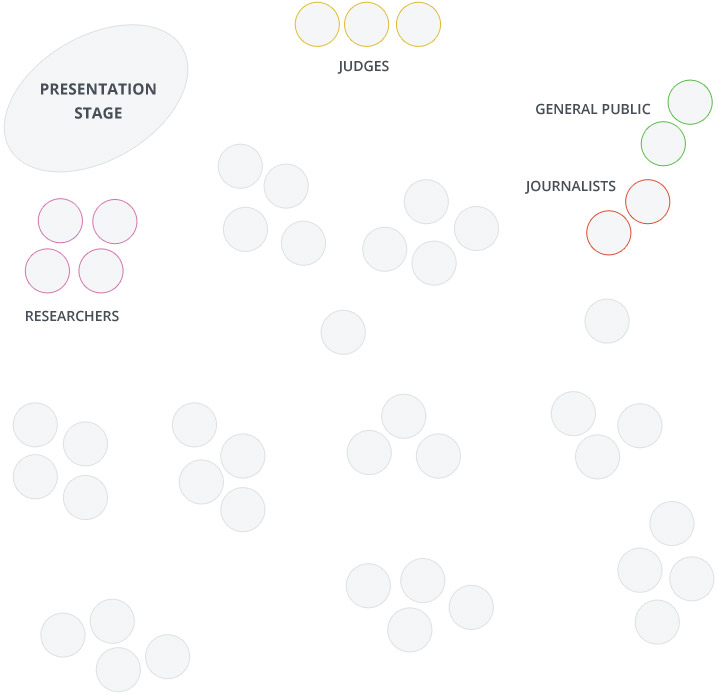
What is your name?
What is the name of the other journalist?
What is the assigned topic for the GAME?
Sketch a professional character profile. Take about 15 minutes to search online for some examples of journalists and their credentials.
What would you like to imagine about your character?
With your fellow journalist, take about 15 minutes in online searches to explore possible pen names for yourselves as well as your intended publication and article titles. You will eventually use these names and titles for the news article you will compile. View the News Article Template that you will be using. Feel free to openly discuss your considerations with your fellow journalist. You could opt to assume complementary roles or be altogether unique.
Review the Code of Conduct under the Rules and Code of Conduct and respond to the questions below.
Which part of the code of conduct do you think you will have no trouble adhering to?
Which part of the code of conduct do you think you may have some trouble adhering to? Why?
You should find out about the assigned topic and the different social science disciplines that are competing for research funding.The following items should help you become more knowledgeable. Complete this as individual work.
Read the Sample Research Proposal. Briefly explain what you understand as the goal of this religious studies research team.
Read the abstracts for each of the disciplines in the Topics and Proposal Abstracts. Beside each discipline name, place a few keywords that help you to understand how that discipline conducts research.
Which of the two disciplines do you feel are most similar? Why?
Which of the two disciplines do you feel are most dissimilar? Why?
Which of two disciplines do you feel you know the least about?
Visit the professional association website for these two disciplines. Navigate through each site for a few minutes. Eventually, jot down a few points you have learned about each discipline. (Search “Canadian” or “American” before the discipline name, followed by the word “Association,” such as “Canadian Political Science Association.”)
Consult a specialized social science encyclopedia in your college library’s e-book collection, book stacks or database. Search for an entry/article on the assigned topic. For instance, The International Encyclopedia of the Social & Behavioral Sciences is a 26-volume specialized encyclopaedia that is available in most academic libraries. Popular encyclopaedias such as Britannica or Wikipedia are inappropriate choices. You may require your assistance from your teacher or librarian for this item.
Take note of the following:
“
“
Page location
Read the Sample News Report. After carefully reading the Sample News Report, address the following questions:
How is the information structured? (chronologically, thematically?)
What kinds of information are featured? (maps, quotes from famous people, funding figures, trends, reactions from…)?
Find two newspaper or magazine articles that have covered research funding issues or events. For each article, identify the following:
| BIBLIOGRAPHIC INFORMATION FOR ARTICLE 1 | |
|---|---|
|
Article title |
|
|
Publication title |
|
|
Author (s) |
|
|
Publication date |
|
|
Page # |
|
|
URL |
|
|
What can be learned from this article and applied towards the writing of your own article? |
|
| BIBLIOGRAPHIC INFORMATION FOR ARTICLE 2 | |
|---|---|
|
Article title |
|
|
Publication title |
|
|
Author (s) |
|
|
Publication date |
|
|
Page # |
|
|
URL |
|
|
What can be learned from this article and applied towards the writing of your own article? |
|
Consult research granting organizations online for insight into issues from within the research granting community. The official website of the Social Science and Humantities Research Council of Canada (SSHRC) is a great place to start investigating. List a few of your discoveries here:
Track down some recent statistics or expert testimony about social science research. Place a few statistics here (add URL for each source of information).
On your own, compose three potential questions for the Q & A period during the GAME PLAY. Try to ask questions to all types of players: judges, general public and researchers.
Journalists are known for keeping detailed records of their inquiries. During the GAME PLAY, take copious notes about what is happening, who is saying what and how; consider taking photographs.
The news article requires accurate accounts of the funding allocations, the presentations and the reactions and discussions that take place. Bring a notepad or a laptop with you to the session.
Please confer with the teacher first about the logistics of using a laptop or taking photographs during the GAME PLAY.
The news article should be composed shortly after the GAME PLAY and completed as specified by your teacher. It can include photographic images as long as you received permission from the players and as long as the distribution of the article is limited to the students in the class. The word count should be between 350-500 words. You can use the suggestions in this template to compose the article.


What is your name?
What is the name of the other member of the General Public?
What is the assigned topic for the GAME?
Sketch a character profile of a member of the General Public. Feel free to openly discuss your considerations with the other member of the General Public. You could opt to assume complementary roles or be altogether unique individuals.
Roughly sketch or find an image of a character that best fits your character preferences. Place it in the box below.
|
|
Review the Code of Conduct under the Rules and Code of Conduct and respond to the questions below.
Which part of the code of conduct do you think you will have no trouble adhering to?
Which part of the code of conduct do you think you may have some trouble adhering to? Why?
The best way to get into a non-scientific mindset is to read or watch some popular media sources of information and public opinion polls. Here are some navigational hints to help you find these sorts of information on the Internet.
Try to locate at least one source on the assigned topic in each of the following three areas:
Copy and paste information and links directly into the relevant fields below.
Provide the following information for the recent newspaper or magazine article:
Extract three brief comments that are of relevance to the public’s views on the topic and place them in the table below:
| OPEN ELECTRONIC COMMUNICATION TYPE (ONLINE FORUM, TWITTER FEED, FACEBOOK…) | GIVEN USER IDENTITY/ONLINE NAME | COMMENT USE QUOTATION MARKS WHERE NEEDED |
|---|---|---|
| 1. | ||
| 2. | ||
| 3. | ||
Find two online public opinion sites with public opinion facts on the assigned topic. Choose from this list:
What did you find?
| NAME OF PUBLIC OPINION SITE & URL | ARTICLE TITLE | RELEVANT FACTS ON PUBLIC OPINION |
|---|---|---|
|
|
|
|
|
|
|
|
|
|
|
|
This speech, delivered in a few short minutes, should inform the Researchers and the Judges that the tax-paying public has its own share of concerns regarding the assigned topic.
If you are not the only player for the General Public, be sure to work on this step together.
Before starting on your own speech, read the Sample Research Proposal to get a sense of what the research teams are presenting for the GAME PLAY. After reading it, copy and paste excerpts from the speech that exemplify scientific ways of thinking:
Read the Sample Opening Speech and then copy and paste excerpts from the speech that exemplify non-scientific ways of thinking:
| THE FOUR PILLARS | QUESTIONS | YOUR ANSWERS (RESPOND AS IF YOU WERE DELIVERING THE ANSWERS FOR A SPEECH) |
|---|---|---|
| A. INTRODUCTION (Start by borrowing material from your STEP 1 - CHARACTER SKETCH.) |
|
|
| B. MAJOR CONCERNS |
|
|
| C. RECOMMENDATIONS |
|
|
| D. CLOSING REMARKS |
|
| CRITERIA | NONE AT ALL | VERY LIMITED | MODERATE | HIGH | VERY HIGH |
|---|---|---|---|---|---|
| 1. | |||||
| 2. | |||||
| 3. |
Practise running through the speech with the other member of the General Public or a fellow student and fill out the CHECKLIST below.
Identify two areas of the speech that need improvement :
Topic: Sustainable Development
General Public: Megan Strett from Nova Scotia
Speech: Delivered in a conversational manner at beginning of the GAME PLAY
Hello distinguished judges and researchers. My name is Megan Strett and I hail from a small town in Nova Scotia. I am a retired bank teller and mother of three and grandmother of five.
I am here at the invitation of the Research Council judges. The judges wanted me to act as a representative of the general public. I will do my best to provide you all with some sense of what the general public may think about the topic of sustainable development. I reckon that means you all expect me to show you how ordinary citizens want the research money spent. That money comes from our tax money. The hope is the judges will make some sound and responsible decisions as to how that tax money should be spent.
You may be wondering what I do that qualifies me to talk about sustainable development. Well, for the last few years I’ve been involved in a local environmental group. I am now the official spokesperson. We are concerned about ocean pollutants and over-fishing off our Atlantic coast. I actually did some homework for a Press Release for our group this week. According to a 2003 Environics poll, 62% of Atlantic Canadians feel greater responsibility should be given to stakeholders in the management, protection, and sustainable use of fisheries and marine resources. Regular folk like us feel left out of the equation, pure and simple!
From where I sit, government folks wheel and deal with other big wheels in large corporations and other government agencies; they rub elbows with each other at black tie events, travelling across large land masses and seas without ever really seeing and touching the real world. They are so far removed from the streets and the streams. The little people like me are intimately involved in our neighbourhood ecosystems. We cannot afford private jets or fancy cocktail gowns.
Hopefully, researchers can find more effective ways to make decisions about the fisheries problems.
A little closer to home, my cousins in Nova Scotia wanted me to tell you of their worries: farm-raised fish companies on or near our coastal waters and sky-rocketing fuel prices.
Frankenfish or “mad fish disease” worries many in my family as there have been mega-fish farms set up all along our coast. As noted by a Fisheries & Oceans Canada study in 2005, “aquaculture issues, such as farming operations, escaped fish, diseased fish, pollution, genetic contamination, capacity” are all of concern to many in the general public living in coastal areas around the country. Our people in Halifax were seen as having the most serious reservations about the sustainability of these new fishing operations. An example of this is my brother Bob catching this ugly creature of a fish. It looked like a skinned rabbit with gills and a beaver tail. Bob says mad scientists are receiving research money by our government to scramble DNA and mess with the natural order of things. Why? God help us!
Gas prices have increased dramatically over the past three years and yet nothing is being done to lessen our dependence on fossil fuel sources for energy. Some serious re-thinking is required. Researchers need to find ways to put the consumers in the driver’s seat. Why not support more organizations like GasBuddy to let the public know the cheapest location to pump up? Let the researchers find ways to undercut the power of giant corporations and petro gangsterism.
It is as if the companies do not care enough about us, the consumers, who are paying such high prices. Corporations are making record profits yet the environment and regular people like me only suffer and lose. This is not sustainable economic development. Regular people are stunted in their development, like the environment which we all depend on for the air we breathe and the water we drink.
Do not accept research funding from these big corporations, as their needs are too well-researched and the regular folk end up suffering. I watch Michael Moore documentaries so I know about how decisions are actually made.
We really need researchers to investigate the high cost of living and the lack of sustainable energy sources for our environment. What are our governments doing to help us? Obviously, not enough. Why is corporate greed so prevalent? Why does economic growth trump sustainable fisheries and affordable fuel sources?
Therefore, I plead for you, as highly capable investigators, to find solutions, viable solutions, ones that normal people can benefit from and feel the effects of in the near future.
Regular folks hear very little about what you do as researchers. I can only hope that your priorities are our priorities; that you can keep corporate greed at bay and find ways to help the little people…please put your investigative skills to practical use.
I thank you, judges, for taking the trouble to include me in these proceedings and hope that I have helped to put a more public face on the problem of sustainable development.
Thank you!
Consider which disciplines to include, all or some, and how well the assigned topic will work for these disciplines.
| PLAYER GROUPS | NO. REQUIRED |
|---|---|
| Journalists | 2 |
| Judges | 3 |
| General Public | 2 |
| Discipline Teams/Researchers
|
33 (3-4 per team) |
| Total | 40 students |
Deliver a brief instructional session* on the following:
*You could arrange in advance to have all or part of the instructional session delivered by library staff, if available. This is highly recommended for teachers new to teaching and to the library’s resources.
These ponderations show the estimated weighting for a three-week compressed version of the Fund$ Game according to the Lecture-Lab-Homework (#-#-#) division of coursework.
Aim to complete the SET-UP and PREPARATION in the first two weeks, reserving the third week for GAME PLAY and POST-GAME WORK. This could be extended by adding an extra week or two to the PREPARATION stage.
See Topics and Proposal Abstracts for The FUND$ GAME
What do you hope to achieve with this assignment?
Overall, what do you think this assignment should be worth?
Set the dates for following through on the four stages (Set-up, Preparation, Game Play, Post-Game Work), culminating in a final due date.
Communicate this to the students before game set-up.
RM LAB #1 Winter 2016
The Fund$ Game
“VIOLENCE”
This game is a simulation of a competition for research funding. It is designed to help you learn more about the dynamics of social science research. Each student is expected to faithfully play the role of a stakeholder (journalist, researcher, general public or judge) and fully contribute to each stage of the simulation, from library research to class presentation. You will be evaluated on the basis of your quality of engagement, script preparation, presentation and reflection.
The game will be played in Week 4 of the lecture class. After the game, each of you will submit a completed script and a reflection (the Journalists will also produce a news article). This collection will be submitted as individual work and will be graded out of 10 lab marks.
Refer to the evaluation grid below for details. Unexcused absences during the simulation will mean you cannot fully complete the lab work.
Student name: _______________________ Student role: ________________________
| Engagement/Quality of intervention/presentation | Complete | Partial | Insufficient | /2 |
| Script | Complete | Indicates limited individual effort | Incomplete/Missing | /4 |
Reflection (300-400 words)
|
Well done | Satisfactory | Needs Work | /4 |
| /10 | ||||
Student name: _______________________ Student role: ________________________
| JUDGE | JOURNALIST | GENERAL PUBLIC | RESEARCHER | ||||
|---|---|---|---|---|---|---|---|
| Quality of criteria/judging | /3 | Substantive news article | /3 | Quality of speech/interventions | /3 | Quality of presentation/team work | /3 |
| Thoughtfully completed script | /6 | Thoughtfully completed script | /6 | Thoughtfully completed script | /6 | Thoughtfully completed script | /6 |
| Well-considered reflection | /6 | Substantive news article | /6 | Well-considered reflection | /6 | Well-considered reflection | /6 |
| /15 | /15 | /15 | /15 | ||||
Journalists (2)
Research Council Judges (3)
General Public (2)
Anthropology (3-4)
Business (3-4)
Economics (3-4)
Geography (3-4)
History (3-4)
Philosophy (3-4)
Political Science (3-4)
Psychology (3-4)
Religious Studies (3-4)
Sociology (3-4)
The students are instructed to provide responses to a few reflection questions. The goal is to have them step back from the game experience and consider how social science knowledge is produced. The parameters for the responses are that each response is written in full sentences, is thoughtfully formulated and makes very specific and concrete references to the game and the textbook (where relevant). The usual word length is 300 to 500 words in total (excluding the question).
Here is an extensive bank of questions that have been used by a variety of teachers. Select the ones that best coincide with your GAME PLAY experience.
Although it may be peripheral from a pedagogical standpoint, making team placards and having a gavel for the judges add authenticity to the GAME PLAY experience.
